Street Paving and Patching
The City of Elkins performs street patching in‑house and contracts out larger repaving projects. This page answers common questions about how paving decisions are made, why some streets are prioritized, and what affects the schedule.
Read on for the answers to frequently asked questions about the paving and patching of streets and roads in Elkins.
FAQs
Q: How much paving does the City of Elkins do each year?
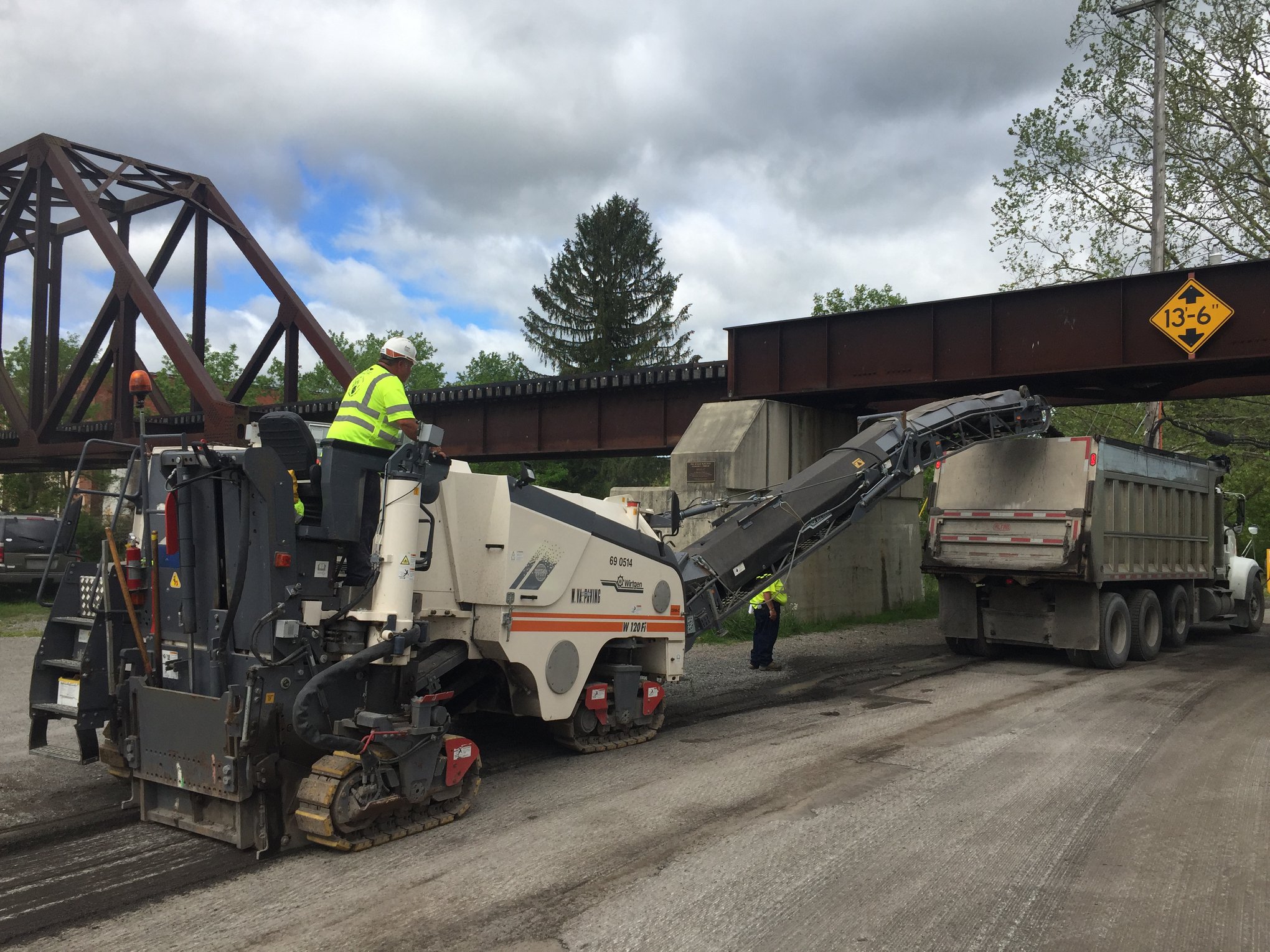
A: Historically, the city has budgeted around $100,000 for street repaving. (That amount increased to $200,000 for FY 2023.) How much repaving a certain dollar amount pays for varies due to price fluctuations. Also, sometimes streets must be milled before paving. Milling, or grinding off the top layer(s) of a road surface, is required when so many successive layers of asphalt have been applied that the road surface is getting too high compared to the curb line.
In 2020, it cost $60,000 to repave about five blocks of Davis Avenue. The cost breakdown was $45,000 for the asphalt and $15,000 for milling.
Q: Some years there is more paving than other years. Why?
A: The main factors affecting each year’s paving operations are contractor availability and weather.
Contractor availability issues arise because the city uses the same paving contractors used by DOH for highway paving projects. Contractors generally prioritize the much larger DOH highway contracts and then turn to projects requested by smaller customers, such as the City of Elkins. (The city’s annual paving projects typically require about 1,000-1,500 tons of asphalt; weeks-long DOH projects might use that amount in a day.)
Because rainfall during the application of new asphalt can harm the integrity of the resulting surface, paving work is usually delayed when precipitation is expected. This can delay city paving projects directly or because a rainy paving season causes so many delays on DOH projects that contractors run out of time for smaller customers like City of Elkins.
As a result of one or both of these factors, it sometimes happens that no paving can be performed at all in a given year in Elkins.
Q: Why doesn’t paving happen year-round?
A: Paving can only occur when hot-mix asphalt is being produced by asphalt plants. Asphalt production is driven by two factors: Weather and demand. If there are large paving contracts being worked on, the asphalt plants will produce hot-mix asphalt (HMA) as long as the weather stays warm enough. Once air and, more importantly, ground temperatures drop below the necessary minimum, paving must stop. At that point, asphalt plants usually suspend production until spring.
Q: They’re paving my street suddenly! Why didn’t I get advance notice?
A: Providing advance notice of paving is notoriously difficult as the City’s paving contractor will often pick a certain area for one day but then just keep continuing the job as the weather is optimal and the week’s weather forecast could indicate sudden change.
Also, the contractor could move the date up suddenly with little notice given to the City; the contractor could see several days of good weather ahead and would rather complete the paving sooner than risk delaying it further because of rain or a drop in temperature.
Q: Why are some streets repaved more often than others? How does Elkins decide which streets to pave?
A: Each year’s paving budget is a finite, limited amount—typically about $100,000. This forces us to pick and choose carefully. Here are some of the considerations that go into selecting streets for repaving in a given year:
- Traffic levels: If there are two streets with a similar level of need for repaving, it makes sense to pick the one that gets more traffic each day. A street with a higher volume of traffic will deteriorate more quickly, and more drivers will be affected as conditions worsen.
- Base failure: In addition to the asphalt top layer of a road, there are base layers that provide the foundation for that surface. Base layers typically outlast many new applications of asphalt on top, but they do periodically need repair and replacement as well. Maintenance to base layers is a separate project from paving. If a road’s deterioration is due to a failing base layer, it makes no sense to replace the asphalt before the base layer can be repaired.
- Utilities: Sewer, water, and gas infrastructure is located underneath most city streets. The state of the infrastructure underneath a given city street may require postponing repaving work. For example, the water mains under a certain block may be known to leak frequently; an upcoming project may require excavation of a sewer line; or the gas company may be planning repairs to its lines. If at all possible, City of Elkins tries not to repave streets that will have to be excavated again in the near future.
Q: What about patching? How and when does the city apply patches instead of ordering a full repaving project?
A: When potholes are detected by city crews or reported by the public, the city does have the option to apply patches as a temporary measure until the street in question is determined eligible for repaving.
Patching can be performed using two different kinds of asphalt. One is called hot mix asphalt (HMA), which is basically the same material used by large-scale repaving projects.
HMA is applied by hand and hardens to structural strength, comparable to the strength of the overall roadway. HMA cannot be stored for any length of time, so it is only available during the time of year when asphalt plants are in production mode. HMA production typically stops in late fall, when ground temperatures drop too low for the application of this kind of asphalt.
The other kind of asphalt used for patching is cold mix asphalt (CMA). CMA can be stored for longer times but is not as effective as HMA. It does not harden to structural strength and deteriorates quickly under truck and other heavy traffic.
Operations Administrative Assistant
Shanna Poe
401 Davis Avenue
Elkins, WV 26241
304-636-1414, ext. 1437 (office)
spoe@cityofelkinswv.gov