Stay Alert, Stay Safe: Why Elkins Residents Must Take Flood Warnings Seriously
The horrific flash floods in the Texas Hill Country this past weekend serve as a stark reminder of how quickly weather can turn dangerous—and how unpredictable extreme events can be.
Here in West Virginia, we know all too well the risks of sudden floods and severe storms, with heavy rains hitting parts of Randolph County hard just last month.
While our state’s rugged beauty is part of what makes Elkins and West Virginia home, the terrain also makes us vulnerable. Steep hills, narrow valleys, roads winding through hillsides and aging infrastructure mean even the shortest burst of heavy rain could lead to flash flooding. That’s why it’s critical to treat every weather alert as if it could be the one that matters—because when it is, it’ll be too late to prepare.
The bottom line: It is easy to tune out texts sent out by the City of Elkins, Randolph County, or the National Weather Service’s Wireless Emergency Alerts. But, please don’t.
Why Forecasts Can’t Always Pinpoint Danger
Weather forecasting technology has come a long way, but nature is still full of surprises: Sudden weather can still blindside the most experienced and talented meteorologists. A storm might weaken before reaching Elkins—or it might stall over Cheat Mountain and dump six inches of rain in two hours. Flooding is less about how many inches of rain fall, and more about where it actually falls and where it flows afterward. A downpour that occurs miles upstream can send water rushing into your neighborhood.
This uncertainty is why warnings use phrases like “potential for life-threatening flooding” or “possible hail up to 2 inches.” The texts you see on your phone, or on the chyron while you are watching television news are not exaggerating—they’re outlining what could happen if conditions align.
“Nah, It Never Floods Here”—Until It Does
It’s easy to ignore alerts when most storms pass without incident. Complacency, however, is dangerous. In 2016, West Virginia’s historic floods killed 23 people, mostly in Greenbrier and Kanawha Counties—many people died in areas that hadn’t seen such devastation in decades. The ages of people who died ranged from 4 to 93 years old.
Sure, the tragedy of 2016 was a “100-year flood” event. But that term is a reminder that a flood can occur at any point in time; it doesn’t mean that a flood will happen only once in 100 years.
When planning for the worst, it’s best to start with a few simple questions:
- Do you know if your home, workplace, or commute route is in a flood zone (as in one of these areas shown here or above?) Check FEMA’s Flood Map Service Center: https://msc.fema.gov/portal/home
- Could you evacuate quickly if roads start to flood? Hint: Never drive through standing water—as little as 6 inches can knock the strongest people off their feet; only 12 inches can sweep away your car or passenger truck.
- Do your neighbors or loved ones need help evacuating? Elderly residents, those with disabilities, or families without reliable transportation may need their community support; that “community” in some cases may only be you.
Make Plans, Both Digital and Analog
The time to prepare for a sudden flood was yesterday. Take these steps today, starting here.
Sign up for the City of Elkins and Randolph County text alerts. Yes, sometimes they overlap for Elkins residents, but that is not always the case:
- City of Elkins Alerts: Sign up for emergency alerts here in just a few simple steps: https://entry.inspironlogistics.com/elkins_wv/wens.cfm
- Randolph County Alerts: Text your ZIP code to 888777 to opt-in or sign up to stay informed of any weather risks: https://www.everbridge.com/products/nixle/
Other options to consider when planning ahead for the worst scenarios:
- Download the FEMA App (Still available as of press time): https://www.fema.gov/about/news-multimedia/mobile-products#download
- If you’re wired to monitor severe weather risks on the internet, bookmark the National Weather Service website, which includes a zip code locater: https://www.weather.gov/nwr/
- In the event you lose access to the Internet, a list of radio stations that could be available depending on your location (and radio frequency) is here.
Now that you’re prepared on the technical side, here are a few extra steps you can take:
- Identify a safe place to shelter if flooding threatens (e.g., an upper floor if your home has one).
- Pack a “go bag” with medications, some cash, bottled water, a flashlight, and copies of important documents.
- Discuss meeting points with family in case cell service fails.
Protecting Your Property
- Clear storm drains and gutters regularly.
- Move valuables and other important documents to higher ground if flood risk arises.
- Consider flood insurance—most homeowners’ policies don’t cover flooding; the National Flood Insurance Program is a solid place to start: https://www.floodsmart.gov/
When Flooding Hits
- Never walk or drive through floodwater: Again, it doesn’t take more than a few inches for water to sweep you off of your feet.
- If you are told to evacuate, go immediately. Routes may close fast.
- Bridges located over fast-moving water? Avoid them.
- If you’re in a safe place and have cell coverage, call 911 to report downed power lines or blocked roads.
Trusted Resources
- American Red Cross – Flood Safety
- National Weather Service – https://water.weather.gov/
- Ready.gov – Floods
We live in a strong and resilient community, but strength starts with preparation. Take alerts seriously—not out of fear, but because protecting what matters is worth the effort.
Invasive species removal at Riverbend Park
Thanks to a West Virginia Division of Forestry Demonstration City grant, the Elkins Tree Board is replacing several invasive trees at Riverbend Park with native alternatives. The invasive Bradford pear, also known as the Callery pear, originated in China and is planted […]
Read More
City Hall News: Week of October 18, 2026
The Elkins Sanitary Board meets Monday, October 19, at 10 a.m. Meeting agendas, packets, and minutes are available through the city’s Agenda Center. Utility and in-city Fire & Rescue Fee bills are due October 20. Third-quarter 2026 Business & Occupation tax returns […]
Read More
Lead the Elkins Police Department
The City of Elkins is seeking an experienced law enforcement professional to serve as its next Chief of Police. This is an opportunity to lead a small municipal police department while remaining close to the work. The Elkins police chief divides time […]
Read More
Treasurer’s Department Returning to City Hall October 5
The Treasurer’s Department will be closed Thursday, October 1, while staff complete their move back into City Hall. The department’s customer service desk will reopen at City Hall, 401 Davis Avenue, on Monday, October 5. Municipal Court will also reopen at City […]
Read More
How Elkins Monitors Your Drinking Water
The City of Elkins tests and monitors its drinking water on an ongoing basis as part of our commitment to providing safe, reliable drinking water to our customers. Water treatment, monitoring, testing, and maintenance of the distribution system take place all year, […]
Read More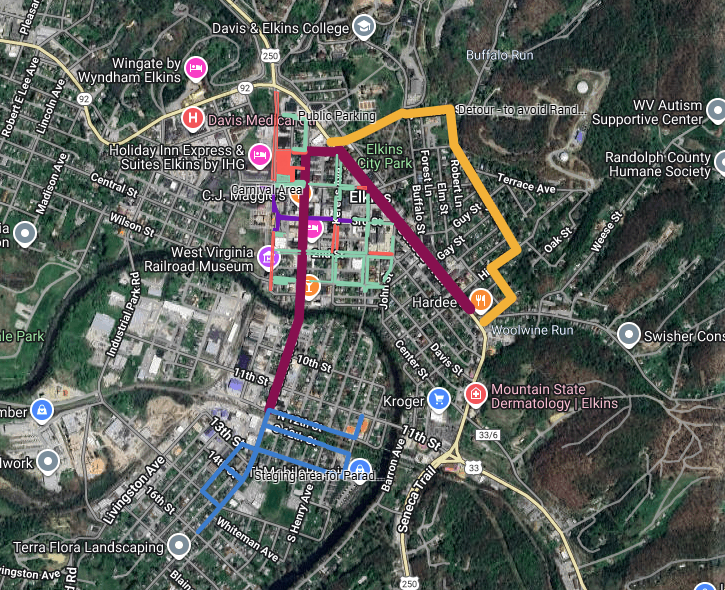
Interactive Map for the 2026 Mountain State Forest Festival
Here is a tentative interactive map for the Mountain State Forest Festival, this year occurring September 26-October 4, 2025. This map is to be used as a guide for the carnival, parade routes, and parking/non-parking areas in and around the downtown Elkins […]
Read More